
Usually not. Most homes in Gloucestershire have a single-phase supply, and most heat pumps, batteries and EV chargers run happily on it. A three-phase supply starts to matter in bigger houses, where the heat pump needs to be large, or where you want two heat pumps, solar, a battery and a car charger all on one supply. We check this at survey, and if an upgrade makes sense, we help you apply for it.
In short
- Most UK homes have a single-phase supply with a main fuse of 60, 80 or 100 amps.
- A 100A single-phase supply is enough for most heat pump homes.
- Larger heat pumps, two heat pumps in cascade, or a lot of kit on one supply can mean three-phase is the better choice.
- Upgrading is done by your network operator. In most of Gloucestershire that’s National Grid Electricity Distribution (NGED). Parts of the Cotswolds and Oxfordshire are covered by SSEN.
- If three-phase isn’t possible or costs too much, there are nearly always other options.
Single-phase and three-phase in plain English
Your electricity comes into the house through a sealed black box called the cutout, usually next to the meter. Inside is the main fuse. That fuse sets how much power the whole house can draw at once.
A single-phase supply is one live cable. It’s what almost every house has. The main fuse is usually 60A, 80A or 100A, and you’ll often see the number printed on the cutout.
A three-phase supply is three live cables. It’s common on farms and businesses, and in some newer or bigger homes. It lets the house draw much more power in total, and it lets big equipment share the load across all three.
Want to check yours? Take a photo of your cutout and meter and send it to us. It’s one of the first things we ask for, because it decides which equipment we can design around.
When does a heat pump need a three-phase supply?
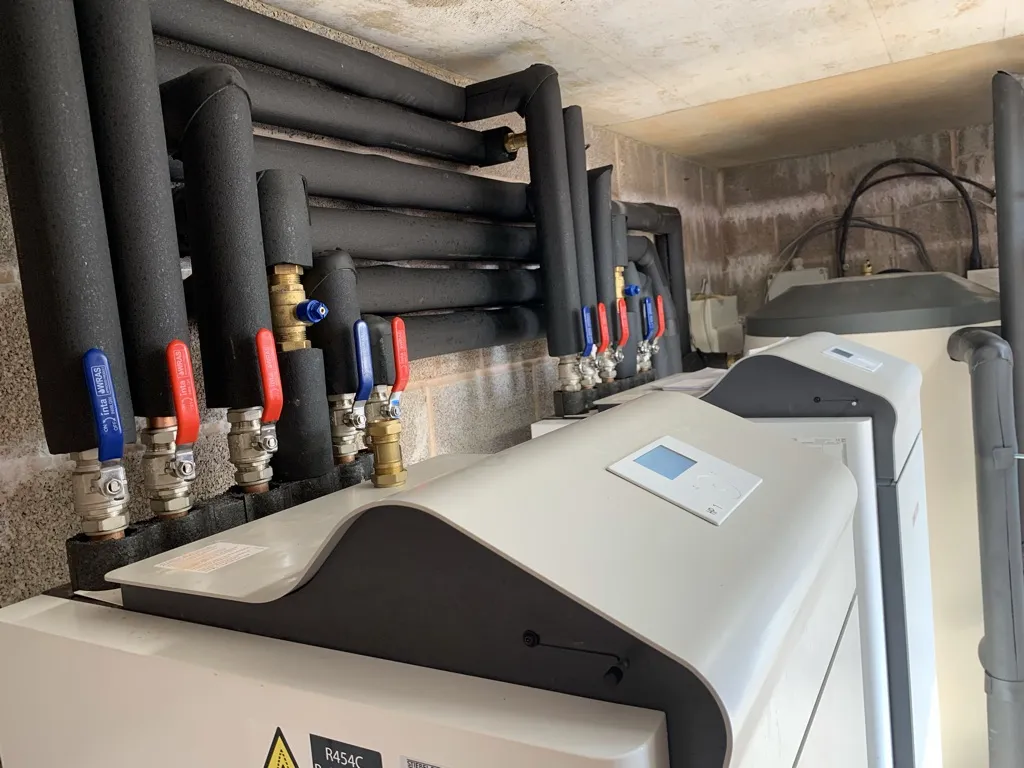
For most homes, it doesn’t. Stiebel Eltron make single-phase versions of their air source heat pumps, and a single-phase ground source heat pump works too. On a barn conversion near Cirencester this autumn, the owners asked if their new 100A single-phase supply would be enough for a ground source heat pump. It is. We just make sure we order a single-phase heat pump, because once the unit is ordered it can’t be swapped.
Three-phase comes into it when:
- The house needs a big heat pump. Some of the largest units are three-phase only. For a large, solid-walled 1850s house in Oxfordshire, our early heat loss estimate was around 19.5 kW. The best fit was a 17.2 kW Stiebel Eltron unit, which needs a three-phase supply.
- You need two heat pumps working together. Two units can run in cascade, sharing the load. Stiebel Eltron confirmed to us this month that their newer air source units can cascade on single-phase or three-phase. The sticking point is whether a single-phase supply can carry both. Even their efficient 13 kW unit needs its own 32A fuse.
- Everything is going on one supply. A heat pump, solar, a battery, an EV charger and maybe cooling all add up. Planned together, a three-phase supply gives room for all of it.
What about solar and batteries?
Solar and batteries also depend on your supply, but in a different way. They send electricity back to the grid, so the network operator has to approve how much you can export. On a normal single-phase supply, the simpler G98 route covers inverters up to 3.68 kW. Anything bigger needs G99 approval first.
Three-phase can help here too. On a home near Cheltenham this year, the owners wanted to add a heat pump to their existing 8 kW solar system. The local network had no spare room for export on their single-phase supply. NGED confirmed a single-phase heat pump would be fine on the existing supply, subject to our own load assessment. They also quoted to upgrade the house to three-phase, which would allow 3.68 kW of export on each phase. So the owners had a real choice, not a dead end.
Sometimes the answer comes back as “not yet”. On a recent battery application for a home near Cheltenham, NGED replied that a network study was needed before the battery could be connected, and passed it to their local team. That’s normal on busier parts of the network. It just adds time.
What does a three-phase supply upgrade involve?
The upgrade is done by your network operator, not by us. It usually means:
- An application. For an existing house on the NGED network, this is a service alteration request. You say what supply you want and what you’ll be running.
- A quote from the network operator. The price depends on how close the nearest three-phase cable is.
- The work. The network operator runs the new supply to your cutout. If a trench is needed on your own land, that’s usually your cost, separate from the network operator’s quote.
- Rewiring inside the house, if needed. Your existing inverter, car charger and the rest of the house can stay on one phase. We plan which circuits go where.
A real example: two very different prices for the same house
In the Forest of Dean, a couple who had just moved in wanted to know if two heat pumps in cascade could work, alongside solar, a battery and possibly cooling. They tried National Grid’s online budget tool and got two estimates for the same house: about £4,700 and about £73,600.
Neither was a real quote. The lower one was for 18.4 kVA, which is actually less than the 100A single-phase supply they already had. The higher one jumped because “2 properties” had been entered, so the tool priced a network extension rather than an upgrade to one house.
Our advice was to skip the budget tool and use the proper service alteration form, asking for a three-phase supply of 3 x 80A, which is about 55 kVA. There’s a three-phase overhead line two or three houses away, so we expect the real cost to be much nearer the lower figure. We’re helping with the load details on the form, and we’ve asked whether they want an EV charger too, because it changes the size of supply they should ask for.
What if three-phase isn’t possible?
There’s nearly always another way. Depending on the house, we can:
- Choose a single-phase heat pump, sized carefully from a room-by-room heat loss survey.
- Reduce the heat loss first, for example with better insulation, so a smaller heat pump will do.
- Use two smaller heat pumps instead of one large one, where the supply allows.
- Manage the load, so the battery, car charger and heat pump don’t all draw full power at once. That’s what an energy management system is for.
As Pete told one customer this month: “If only a single phase is available we can still provide everything.” It just changes the design.
How PBT Installations helps
We look at your supply first, not last. At survey we check your cutout, main fuse and meter, then design the heat pump, solar, battery and car charger around what you have, or what you could have. If an upgrade makes sense, we’ll tell you what to ask the network operator for and help with the load details. For heat pumps, batteries and solar, we make the connection application to NGED ourselves through the Energy Networks Association’s Connect Direct portal.
It’s part of designing one system for the whole home: heat pump, solar, storage and control, engineered together, not bolted on.
Three-phase supply FAQs
How do I know if I have a three-phase supply? Look at your cutout and meter. Three-phase homes usually have three fuses in the cutout, or a single cutout marked as three-phase, and a larger meter. Don’t go by the box alone, though. We recently saw what looked like a three-phase cutout with only a single-phase connection. The easiest way is to send us a photo and we’ll tell you.
Is 100A single-phase enough for a heat pump? For most homes, yes. The heat pump needs to be single-phase and sized properly, and we check the total load with your other equipment before we design anything.
How much does a three-phase upgrade cost? It depends on how far the nearest three-phase cable is from your house. Online budget tools give a rough guide at best. You’ll only know the real figure from a quote by your network operator.
Who applies for the upgrade? The request goes to your network operator. We’ll tell you exactly what supply to ask for and help with the load details on the form.
Does a supply upgrade affect the heat pump grant? No. The Boiler Upgrade Scheme grant is £7,500 towards an air source or ground source heat pump. The higher £9,000 grant is only for off-gas-grid homes replacing oil or LPG, and only until 31 March 2027. The grant goes towards the heat pump installation, and the network operator’s upgrade charge is separate.
Can I add a battery or EV charger to a single-phase supply? Usually, yes. Larger systems need G99 approval from the network operator, and we handle that application for you.
Not sure what your supply can take?
Send us a photo of your cutout and meter, and we’ll tell you what your supply can handle. Or book a free survey and we’ll look at your supply, your heating and how you use energy, then recommend a system that fits.
or call 01242 323923 · email [email protected]
PBT Installations is MCS certified (NAP-264271), NAPIT registered and TrustMark endorsed.