
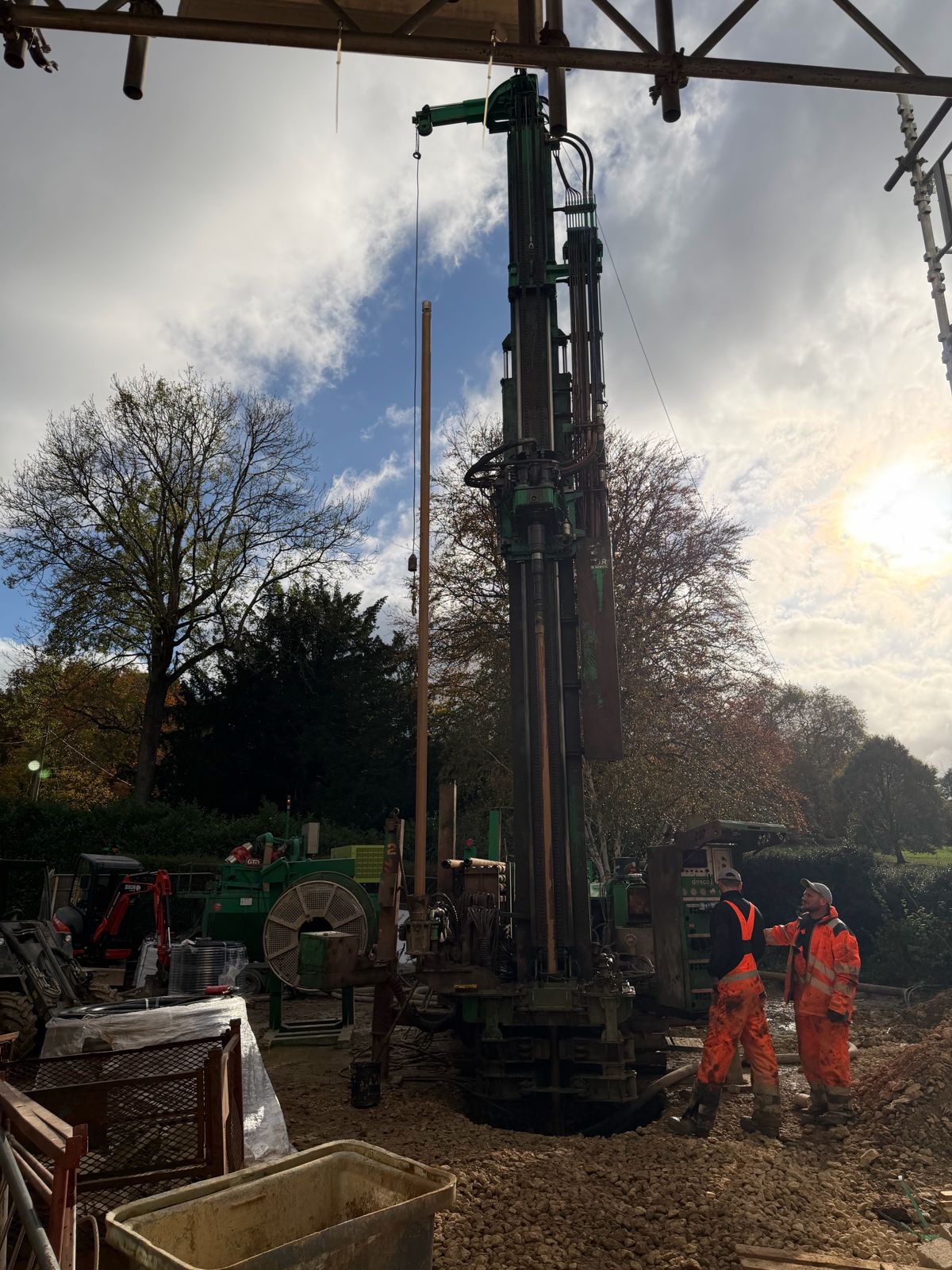
If you’re thinking about a ground source heat pump, one of the first questions is how the heat gets out of the ground. You’ll hear about ground source heat pump boreholes and horizontal ground loops, and it’s not always clear which one your home needs, or why.
The short answer: boreholes suit homes with a high heat demand or not much spare land. They go straight down rather than across the garden, and deep ground stays at a steady temperature all year. What matters is that the number and depth of boreholes are designed around your house and the ground under it, not guessed.
In this article
Ground source heat pump boreholes or a ground loop?
A ground source heat pump takes heat from the ground through a loop of pipe filled with fluid. That pipe can go in two ways:
- A horizontal ground loop. Pipe laid in trenches about a metre or two down. It needs a large area of open land.
- Vertical boreholes. Pipe lowered into deep holes drilled by a specialist rig. They need far less land, and the deeper ground gives a steadier temperature through the coldest weeks.
For a bigger house, a horizontal loop would need a lot of land. Boreholes are often the practical answer.
It starts with a proper heat loss calculation
Before anyone talks about kit, we work out exactly how much heat the house needs. That means a room by room heat loss calculation to BS EN 12831. (If you’re not sure where to start, see is my home ready for a heat pump?)
That calculation gives the heat load in kW and the heat the house needs over a year in kWh. It’s the number everything else is designed around, including the boreholes. Get it wrong and the house is either cold in January or you’ve paid for a bigger system than you need.
Why the ground is checked first
How much heat you can take from a borehole depends on the rock and groundwater underneath, and you can’t tell that from the surface. On larger systems, a thermogeological assessment of the site is used to set the number and depth of the boreholes, and how far apart they need to be.
This step protects you as the homeowner. Too little borehole and the ground can cool down over the years, which hurts performance. Too much and you’re paying for drilling you don’t need.
How many boreholes, and how deep?
There’s no standard answer. The number and depth of boreholes come from two things: how much heat the house needs, and how much heat the ground underneath can give. A smaller, well insulated home might need a single borehole. A large house with a high heat demand might need several, each drilled to a depth of 100 m or more.
Where there’s more than one borehole, they’re spaced apart so they don’t draw heat from the same patch of ground. Drilling is done by a specialist rig, and how long it takes depends on the number and depth of the holes and the ground conditions. Once the loops are in and connected, there’s very little to see above ground.
What happens after the boreholes are drilled
Once the boreholes are drilled, the usual steps are:
- Grouting and testing. Each borehole is grouted to seal it, and the loops are pressure tested.
- Connecting the manifold. The loops are joined at the manifold chamber and the header pipe is connected back to the house.
- The plant room. The heat pump, tanks, cylinders and controls are fitted and piped together.
- Filling and commissioning. The system is filled, flushed and set up, and the controls are programmed around the house.
Frequently asked questions
Do all ground source heat pumps need boreholes?
No. Homes with plenty of open land can often use a horizontal ground loop instead. Boreholes suit homes with a higher heat demand or less space.
How deep are the boreholes?
It depends on the ground and how much heat the house needs. The depth and number are set by the heat loss calculation and an assessment of the ground. A larger home may need several deep boreholes, while a smaller one may need just one.
Will boreholes take over my garden?
Far less than a horizontal loop. Once the boreholes are drilled and connected, the pipework is underground and the land above can be used as normal.
Is ground source right for every house?
No. Every job starts with a proper heat loss calculation and an honest look at whether your site suits boreholes, a ground loop or an air source heat pump instead. If ground source isn’t right for your home, we’ll tell you.
Talk to a local ground source heat pump installer
PBT Installations is an MCS certified (NAP-264271), NAPIT registered, TrustMark endorsed heat pump installer based in Cheltenham, working across Gloucestershire and the Cotswolds. We design the heat pump, ground loop and plant room together, as one system for the whole home.
Read more about our ground source heat pumps or our work as a heat pump installer in the Cotswolds.
If you’re thinking about ground source for a larger home, call us on 01242 323923, email [email protected], or book a free survey.