
Heat pumps, solar panels and batteries cut your energy bills. But can they also add value to your home? The honest answer is usually yes, though mostly indirectly, through a better energy rating, lower running costs that buyers can see, and a home that’s ready for the way energy ratings and rules are changing.
Here’s what the evidence shows, how each technology helps, and how to get the most value from an installation.
In short
- A better EPC rating is linked to a higher price, especially when a home moves up from a poor rating. The size of the premium varies between studies.
- Lower running costs are a real selling point. Homes rated A to C have much lower typical fuel costs than D or E rated homes.
- Energy ratings are changing. New EPCs, expected from the second half of 2027, are designed to recognise heat pumps, smart controls and batteries better than today’s ratings do.
- Quality and paperwork matter. A well-designed, certified installation with full records adds far more confidence than one without.
What the evidence says about value
Two large UK studies have looked at energy ratings and house prices.
Rightmove studied around 300,000 homes that sold twice over 15 years with a different EPC rating each time. On top of local house price growth, improving the rating was linked to an average extra increase in value of:
| EPC improvement | Average extra increase in value |
|---|---|
| F to C | 15% |
| E to C | 7% |
| D to C | 3% |
Nationwide compared similar homes at the same point in time, and found a smaller effect. Homes rated A or B were valued around 1.6% higher than a similar D rated home, about £4,500 on an average house in England, while homes rated F or G were valued around 1.4% lower. For buy-to-let homes, the A or B premium was much bigger, at 12.2%.
The two studies measure different things, so the numbers aren’t directly comparable. What they agree on is that the biggest gains come from lifting a home out of a poor rating, which is common in older properties, including many stone homes in the Cotswolds.
Buyers are paying attention too. In Nationwide’s research, 77% of homeowners said an EPC rating will matter when they next buy, and almost half of 25 to 34 year olds said it would be very important.
Lower running costs that buyers can see
Every EPC shows a home’s estimated energy costs, so buyers can compare running costs before they make an offer. Nationwide found that homes rated A to C have median fuel costs around £400 a year lower than D rated homes, and around £1,200 a year lower than E rated homes.
A well-designed heat pump, paired with solar panels and a battery, can bring those costs down further. Read how to cut heat pump running costs.
How each technology helps
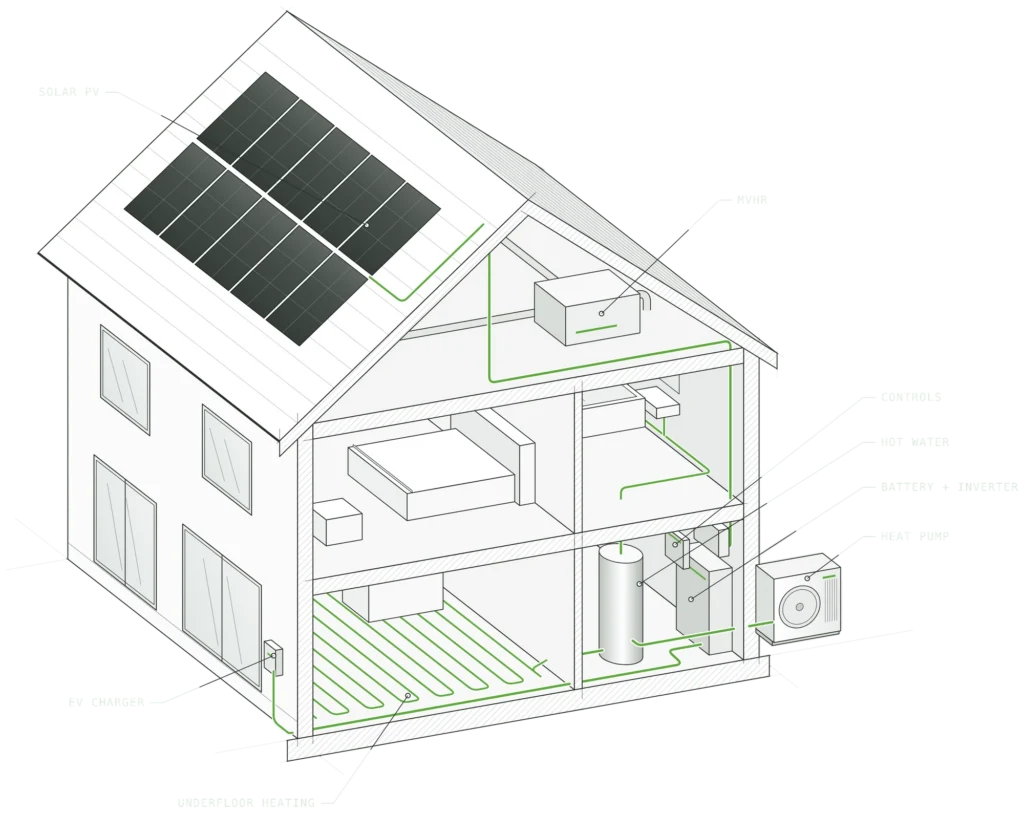
Solar panels
Solar panels generate your own electricity and improve your EPC rating. They’re the most common energy upgrade: in Nationwide’s research, 55% of homeowners who had made energy improvements in the last ten years had added solar.
Battery storage
A battery stores solar electricity, or cheap overnight electricity, for when you need it. The new EPC is expected to include a smart readiness measure that recognises battery storage working with the grid.
Heat pumps
An air source or ground source heat pump replaces fossil fuel heating. Today’s EPCs can score heat pumps below older gas boilers, but the new heating system measure is expected to use updated figures that reflect today’s cleaner electricity grid, which should treat heat pumps more fairly.
Insulation, ventilation and controls
Insulation and airtightness lower your heat demand and improve the fabric of the home, while smart controls and an energy management system make sure the energy you generate and store is used well. Designing these together is what we mean by a whole-home system.
The new EPC is on its way
The government is replacing the single A to G rating with four measures:
- Fabric performance: how well the building keeps heat in.
- Heating system: how clean and efficient the heating is.
- Smart readiness: smart controls, batteries and the ability to respond to the grid.
- Estimated energy cost: what the home is likely to cost to run.
The new certificates are expected from the second half of 2027, and existing EPCs stay valid for ten years from when they were issued. Homes with a heat pump, solar, a battery and good controls should be well placed under the new system.
If you let out a property
The government has proposed that privately rented homes should reach EPC C by 2030, with legislation still to follow. Under the new EPC, the proposal is that C would need a C on fabric performance plus either the heating system or smart readiness measure, and fossil fuel heating on its own is unlikely to get there. For landlords, renewable technology may become a way to keep a property lettable, as well as to add value.
How to get the most value from an installation
- Design it properly. A system sized from a room-by-room heat loss calculation runs efficiently and keeps bills low. A poorly installed system can put buyers off, as our Ledbury case study shows.
- Keep the paperwork. Your MCS certificate, warranties, commissioning records and service history reassure buyers and surveyors. An MCS certificate is also needed to get paid for the solar electricity you export.
- Get a new EPC after the work. Your old certificate won’t reflect the improvements until it’s updated.
- Keep it serviced. Annual heat pump servicing keeps the system efficient and the warranty valid.
- Make use of the grant and 0% VAT. The Boiler Upgrade Scheme gives £7,500 off a heat pump, or £9,000 for oil and LPG homes, and 0% VAT applies to heat pumps, solar and batteries. Both the £9,000 rate and 0% VAT end on 31 March 2027. Read our guide to the heat pump grant after the Budget.
Frequently asked questions
Do solar panels add value to a house?
They can. Solar panels improve a home’s EPC rating and lower its running costs, and both are linked to higher prices. The effect depends on the home, the size of the system and the rest of the market, so no one can promise a set figure.
Does a heat pump put buyers off?
Some buyers are less familiar with heat pumps than with boilers. A well-designed system with lower running costs, a full set of paperwork and a good service history helps reassure them. As heat pumps become more common and the new EPC treats them more fairly, they’re likely to be seen more and more as a selling point.
Are leased solar panels a problem when selling?
They can be. Panels on a lease or “rent-a-roof” scheme belong to another company, which can complicate a sale or a mortgage. Panels you own outright are much simpler for buyers and lenders.
Do renewables work in older Gloucestershire homes?
Yes, with the right design. Read about heat pumps in old Cotswold stone homes, and see how we heated a 1750s stone cottage.
Talk to us about your home
We design and install heat pumps, solar panels, batteries and controls across Cheltenham, Gloucester, Stroud, Cirencester, the Cotswolds and the Forest of Dean. We’ll look at your home, explain what would make the biggest difference, and give you a clear, itemised quote.